It’s impossible to spend any time in Austria without observing constant reference to one of the nation’s most remarkable exports: Red Bull. Dieter Materzitch’s Austrian empire is vast, with his devotion to extreme sports and machinery being most visible at Hangars 7 and 8. These hugely dramatic and cavernous structures are home to numerous of Red Bull’s most important and iconic machines – from the worlds of motor racing, aviation and wider extreme sports.
The buildings themselves are other-worldly – huge monuments to the success of the energy drinks brand. Situated just to the side of Salzburg Airport, the two hangars face one another, flanking a concrete apron leading out onto the airport. Hangar 7 is the larger and is open to the public (for free) year-round. Hangar 8 is used solely for storing aircraft.

Hangar 7 shows equal appreciation for architecture, engineering and cuisine. Featuring specially-selected plants, it offers an atmosphere of unrivalled opulence, combined with an eerie calm. It’s all delivered with a measured self-assurance that we awkward Brits would struggle to countenance, let alone realise.


The building itself is a masterpiece; wrapped in glass with the walls and roof forming a parabolic whole, the fenestrated shell delicately resting on a perfectly wrought, curving steel endoskeleton. Those massive curves and distant panes create a tremendous sense of both space and isolation.
I’m no Kevin McCloud but suffice it to say that Hangar 7 is far more remarkable in the flesh than any photo might convey. The collection within is equally impressive with a diverse smattering of products from Red Bull’s back catalogue. Of greatest interest to us are, naturally, the racing cars – and there are plenty of those. Grand prix weapons from Sauber, Red Bull Racing and Toro Rosso remind one of the company’s unique achievements. Imagine telling Enzo Ferrari that his beloved red cars would one day be vanquished around Monza by the product of a caffeinated beverage manufacturer.

There are examples on display from each of the Milton Keynes team’s title-winning seasons, as well as the very Toro Rosso in which a youthful Sebastien Vettel put the manners on the old guard at Monza in 2008; establishing himself as the buoyant, smiling assassin. From America are the Dallara IndyCar which transported Tomas Scheckter to victory around the fearsome banked Michigan International Speedway and an example from Red Bull’s foray into NASCAR team ownership.


There are scores of aircraft on display – as one might rationally expect from a hangar. The Flying Bulls is the arm of Red Bull which cares for the company’s aviation treasures and they are immaculately presented; both fixed wing and rotor blade varieties. The jewel in the crown is the Douglas DC-6B. Having spent time in Yugoslavia and Zambia, it has been with the Flying Bulls about 15 years, having been brought back from Africa where it was used for tourism and promotional purposes. Now carrying a highly-polished skin and four new 18 cylinder Pratt and Whitney radial engines (2,400hp each…), it’s a fitting centrepiece for the collection.

Almost as elegant is the twin-boom Lockheed P-38 Lightning which was rescued from Greenland after a forced landing during the Second World War. Wearing a similarly polished exterior, the P-38 is the only example left flying in Europe and spends its morning gleaming on the apron outside Hangar 7. We can only hope Lord March might proffer an invitation to fly at Goodwood one day.
While the building and its vehicular contents are remarkable, Hangar 7 is equally famed for its culinary offerings. Sadly we can only stretch to a coffee but it’s delivered with the class one might expect. In keeping with the Germanic countries, there are little moments of humour, such as the way-faring sign for the lavatories featuring the traditional male and female silhouettes dangling from parachutes.

While a clear demonstration of its own financial clout and global pre-eminence, it’s hard to fault the Red Bull Hangars. Visually they are magnificent, with the contents maintained perfectly and displayed beautifully. The backdrop of snow-kissed mountains is as spectacular as that blessing any museum in the world. And all this without an entry fee.

Sated with coffee, it’s time to get comfortable in the Aston again as we’ve got quite a bit of ground to cover today and we want to enjoy some great roads. The initial chunk of the journey is deathly dull. Reduced speed limits are imposed on the autobahn as we slowly work our way around Innsbruck and the scenery is great, but feels somehow distant; we’re in its vicinity but not really part of it.
That feeling of separation from our surroundings is eased considerably when we clear Innsbruck and dive north towards Reutte on the 179. Once more we are purring over rolling green meadows, chasing distant mountains. At Reutte we bank west and take the 198 – an inspired choice as it transpires.
Traffic on both roads is mercifully light and the 198 in particular feels genuinely supercar-sized. It’s broad, smooth and well-sighted; blessed with long straights and broad, open-radius bends. The beautiful natural vistas are broken occasionally by bizarre villages; all gothic script, theatrical battlements and creepy wall murals. It’s a bewitching (perhaps literally) brew.


Towards the end of the run – and with me in the driving seat meaning I’ve no idea where we were – we elect to take a twisty route merely out of curiosity and because we’ve made decent time. It feels as if we’ve climbed 1000 feet. The snow banks have closed in to hug the verge and there’s water cascading off the tops of the open-sided tunnels. The snow drifts have organised themselves into huge fluffy pillows, punctuated by similarly-sized tufts of green grass.


If this heady mix of creepy villages, jagged mountains and petrolhead plains wasn’t enough, we encounter a cattle drive ambling along the road and a brief road closure where a group of intrepid chaps is chiselling at a cliff face. They look as surprised to see us as we do them.


All good roads must come to an end and eventually we emerge back into civilisation at the south eastern tip of Lake Bodensee. Bordered by Switzerland, Austria and Germany, Bodensee is vast and we meander along its northern shoreline, passing vineyards as we go and, sadly, out of time to visit the local Zeppelin museum. Next time…
Our destination for the night is Bodman-Ludwigshafen, a pretty village which dips its toes into the water at the lake’s most north westerly point. Our hotel is simple and clean with ample underground parking and a quick five minute walk to the water’s edge. Bodensee is on a scale not dissimilar to the great Italian lakes, though the atmosphere doesn’t feel quite so romantic. It’s calm and picturesque, with the surrounding village feeling nicely preserved and undisturbed. I wouldn’t advocate travelling a huge distance specifically to see Bodman-Ludwigshafen but it’s a charming place to stop on a big trip like this one.


From the enormous Lake Bodensee, it’s time to head virtually due north and into the Black Forest. I’ve had a tip-off about the B500, supposedly a pretty special stretch of road – and conveniently one which leads towards our next destination.
We join the B500 at the amusingly-titled Titisee and follow it north through Triberg and on to Hausach. It’s typical of German country roads, blessed without hedgerows to crowd the views and punctuated by white marker bollards to help you trace a path. This provides great visibility and allows you to plan far in advance of the typical British equivalent. The countryside is broad, with rolling green pastures extending out in all directions. There are rugged hilltops in the distance but this isn’t Alpine terrain by any means. The route is dotted with occasional clutches of tall, coniferous trees close to the road but much of the arboreal action is set back from the macadam, organised into neat forests. It’s picture-postcard stuff, but in an entirely different manner to the grandeur of Austria the day before.


The road itself is awesome – with the potential to rise into severely licence-threatening speeds without a little restrain. There are a few hairpins but much of our drive up to Hausach is simply through glorious, open sections, gently rising and falling with the natural elevation of the land. It’s one of those roads you just want to turn around and enjoy again.

Sadly we’ve no time for such frivolous shenanigans for we have an impending visit to a model railway. Schwarzwald Modell Bahn is, at over 400m2, Europe’s largest model railway replicating actual scenery. That is to say, there may be bigger model railways in Europe but they depict fictional worlds. Schwarzwald is the Black Forest Railway, rendered in miniature.
There comes a time in every man’s life when he is old enough to admit that he likes model trains. Having been a childhood enthusiast, I was wowed first by Scalextric, then by radio controlled buggies, before passing my driving test and obsessing over real cars. At one time I was vaguely interested in girls. Now, though, I’m comfortable with admitting that watching tiny trains traversing miniature worlds is beguiling.
The layout at Schwarzwald is as detailed as it is massive. It snakes its way around its exhibition hall in a seemingly-infinite, serpentine loop. It even ascends and descends spiral towers to clear a doorway. Ducking in and out of walls and featuring a couple of different stations, there’s an easy couple of hours’ exploring for even the casual locomotive lover.


I learn from my co-pilot that the continental scaling for model locos is slightly different to the traditional UK 00-gauge. This means the rolling stock is better-proportioned – and you can tell. The scenery is spectacular and the lights replicate the movements of the sun as the room lightens and dims over time, offering the chance to explore the layout under cover of darkness, twinkling station lights and illuminated carriages guiding the way.


The detail and quality of the modelling is exceptional, with dad suggesting it’s as good as he’s ever seen. The sheer size of the layout is impressive and gives plenty of room for everything to breathe. There are farms and quarries and hotels and campsites and classic car garages nestling among the hills, streams and bridges. Autonomous road vehicles glide along track-less highways on pre-ordained routes, as if by magic.


It’s pretty mega and definitely one to check out if you find yourself in the Black Forest. Embrace your love of model trains.
Sadly, though, we have yet more ground to cover and from southern Germany we need to get up to Belgium in time for a good night’s sleep. I take the wheel for this leg and endure my now-traditional boring blaze up through France. It’s not a memorable drive, mercifully, for it rains and takes us through long sections of rather monotonous countryside. Still, a warm welcome greets up at our favourite Belgian hotel, Château Bleu near Trooz. I wouldn’t dare stay anywhere else.
While Trooz itself is worthy of mention only to recommend avoiding it if possible, the surrounding countryside is lovely and well worth exploring. Château Bleu has become our default choice when visiting Spa-Francorchamps. It’s a pleasant 30 minute drive to the track, as well as serving the best bread and pastries east of Paris.
The FIA has conveniently scheduled the Spa round of the World Endurance Championship to coincide with the last leg of our trip. Sadly commitments in the UK mean we can’t stay for race day but we can watch free practice and qualifying. We reason that a day watching LMP and GTE cars blasting around Europe’s finest circuit will be pretty ace, even if they’re not bashing wheels for position.
Fortunately the scheduling for the day is fairly relaxed and that gives us chance to head over to Abbaye Stavelot – the museum a few miles from the circuit which includes an area dedicated to the history of the great track. The Abbaye itself is an ancient monastery with a documented history dating back almost 1500 years.

Having traced part of the route of the ‘old’ Spa layout and savoured the awesome flow of the Masta Kink, it’s alarming to find ourselves bouncing over traditional Belgian pavé. Still, we eventually come to rest in an underground car park and head off to explore the motor racing collection within the museum – housed in the old cellars framed by evocative brick arched ceilings. It’s strange to find so many great cars stored in absence of natural light, but it provides an earthy feeling which is reassuring for those of us in love with the sport’s history. Imagine the musty realism of the now-defunct Maranello Rosso collection.


The museum isn’t huge but it’s packed full of fascinating exhibits which span Spa’s special history as a venue for all levels of the sport. There are examples from the worlds of junior single seaters, GTs, touring cars, sports racers, F5000, IndyCar and F1. Whether you love the 1970s kit-car era of F1, modern sports prototypes or evocative Group 1 saloonatics, you will find an exhibit or two to pique your interest. The cars are interspersed with displays and videos from the venue’s rich history.


The jewel in the crown is a brace of Gulf-liveried sports racers. The JWA Porsche 917 needs little introduction and this is a genuine Wyer car – chassis 013 – and now resides in the hands of Mark Findburgh. Sitting alongside is an example of the gloriously sonorous and equally gorgeous Lola-Aston Martin B09/60. It doesn’t get much better than these two.


As diverting and atmospheric as the Abbaye is, it doesn’t justify a long visit and we’re soon itching to get trackside – to see motor racing history as it happens. We take the chance to explore a leg of the old circuit which neither of us has driven previously – from the awesome banked Stavelot (now a one-way right-hander outside the town) through to the road’s conclusion at the current Stavelot bend. It’s a phenomenal run, with the road flowing down gentle sweepers and it’s impossible not to let the Aston off the leash a little. No wonder the Belgians decided to turn these dusty trails into a race track – they’re mega.
We park up opposite the old pits, just near the old Eau Rouge hairpin (as it once was) and wander over to the paddock where Fred Makovici and Tom Kristensen are donning their helmets and climbing into road-going Porsche 911 and Audi R8 respectively to treat a couple of lucky passengers to the rides of their lives. Both drivers are straight on it – blasting up Radillion and away along the Kemmel Straight in a blare of revs. We try to suppress our jealousy.

Practice for the Porsche Carrera Cup GB has just finished and the cars are pushed out of parc fermé and the drivers are milling around. Champion-elect Dan Cammish (even in early May the title momentum is with him) is looking especially relaxed. Sadly there’s some timetabling confusion and the advertised pit lane walk-about has already occurred so there’s nothing for it but to trek up the hill, following the cars clockwise to watch WEC practice kick off.

We start the session about half-way along the Kemmel Straight, with all cars at pretty much terminal velocity, hammering towards Les Combes in top gear, just as so many generations of sports racing cars have done before them. Even having seen them at Silverstone a few weeks earlier, the variety of shapes, sounds and colours delight.

It’s staggering standing at the turn-in point for Les Combes; that little bit of gradient enables everyone to brake so late, with the GTE cars making the finest sounds and the LMP cars bewildering with the speed they carry to the first apex. It’s a blur. A virtual safety car gives us a couple of minutes’ grace so we duck under the track at the tunnel between Les Combes and Rivage. This brings us out above the nameless left-hander and with the iconic view of the valley reaching across to the pitlane. No petrol head could tire of that vista.


Behind our heads, the cars are above us but they start plunging downhill, carrying huge speed towards Rivage. This is one of the finest spectator spots in world motor racing – you can really watch the drivers at work. The quick cars (LMP1, F1 and the like) are accelerating tremendously hard downhill before exercising maximum retardation and tipping into the endless Rivage right-hander, the road dropping away throughout the process. The ferocity of their motion at this point is shocking. The backdrop of decrepit caravans lining the outside of the course serves only to make these space-age racing cars seem even more other-worldly. It’s absolutely magical.


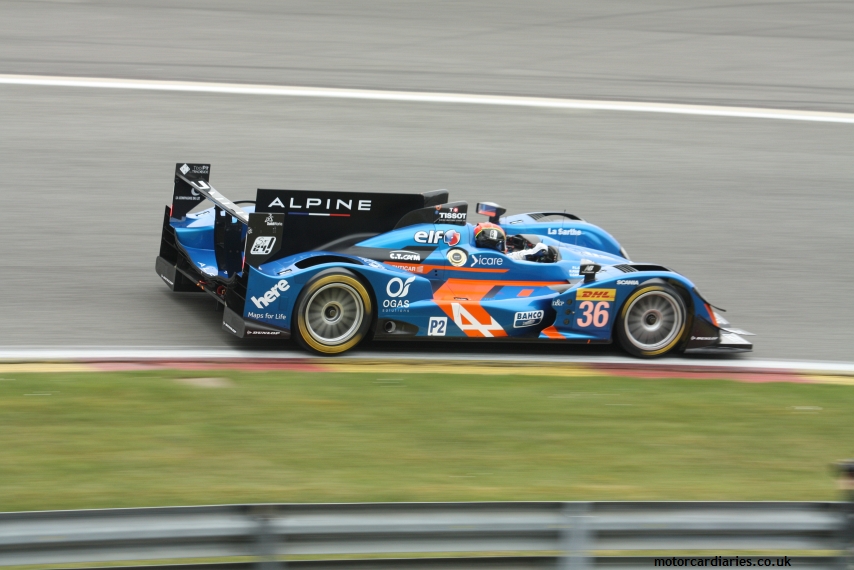
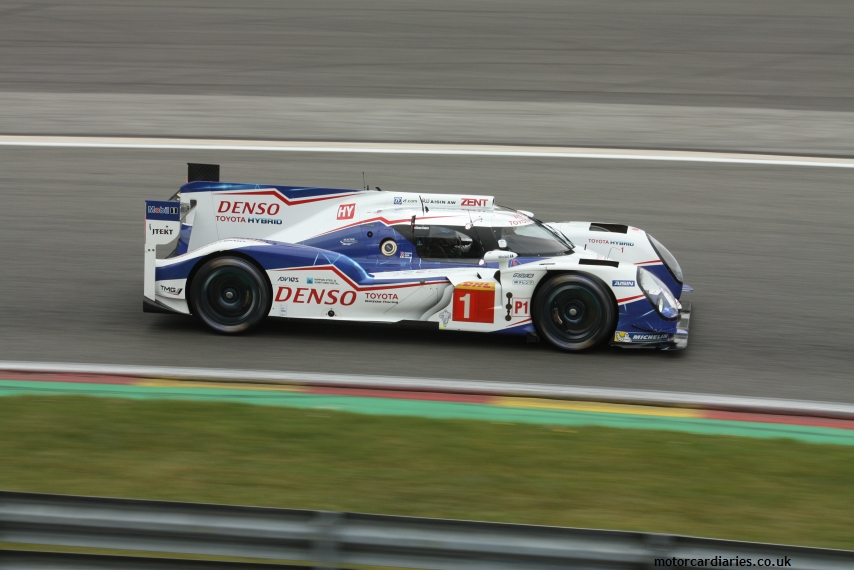


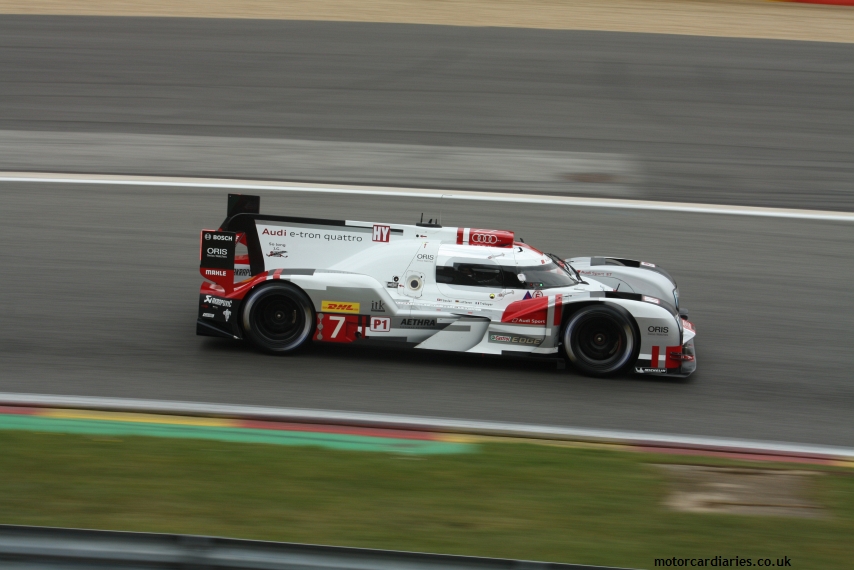
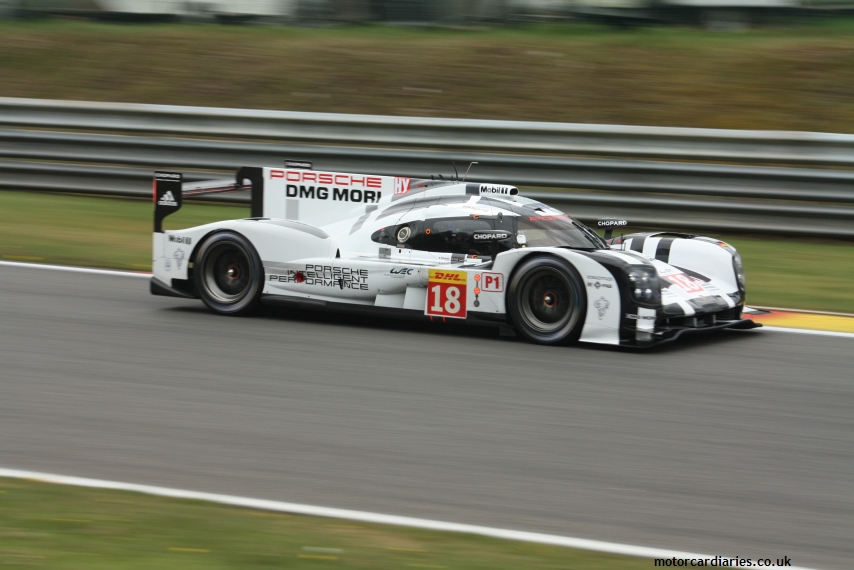
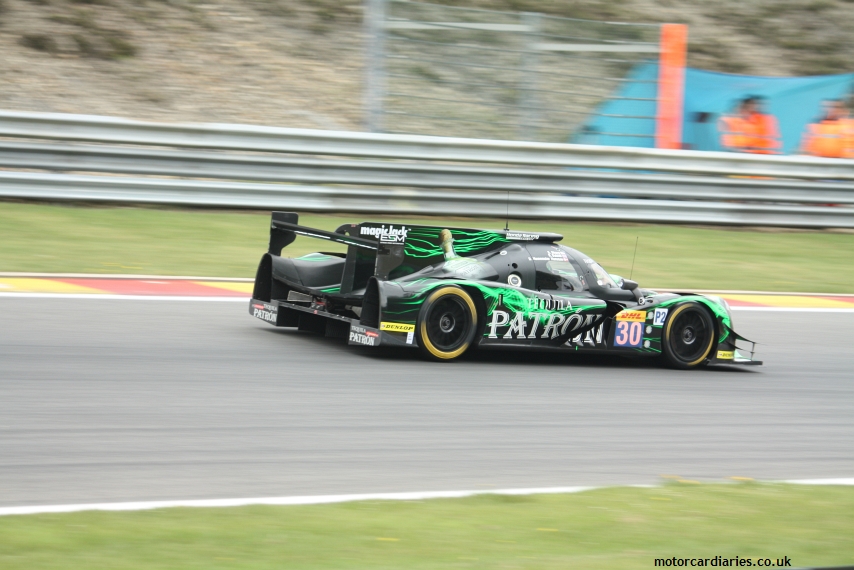

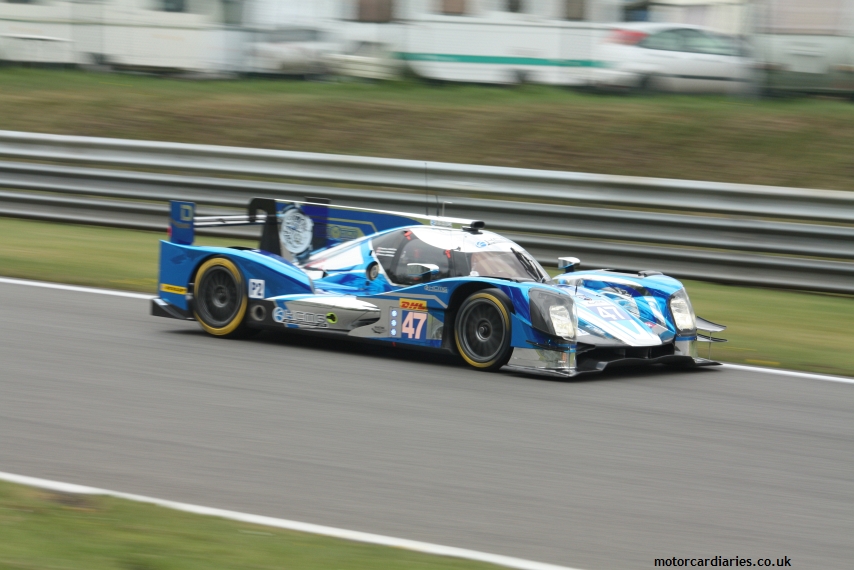
All too soon the session is over and we’re left to lament the lack of track time for the WEC. Next time we’ll head back for race day. We trace the course clockwise and find ourselves on the outfield at Blanchimont for the start of the Porsche Carrera Cup GB race. It remains one of the great places to watch racing cars – any racing cars – as they seem to dive-bomb towards your feet as they aim for the second apex.
This race is unusual for the 2015 championship as Dan Cammish has to accept second place. Reigning champion Josh Webster is flawless in defence as he holds Cammish at bay for the duration of the race. Just when he appears to have a few car lengths’ breathing space, Webster faces a new onslaught from the young pretender. Cammish has to settle for the second step of the podium and fastest lap for his efforts. Behind the duelling duo, it’s a surprise to find former champion Michael Meadows lose it under braking for the Bus Stop and take to the run-off area, broadside.


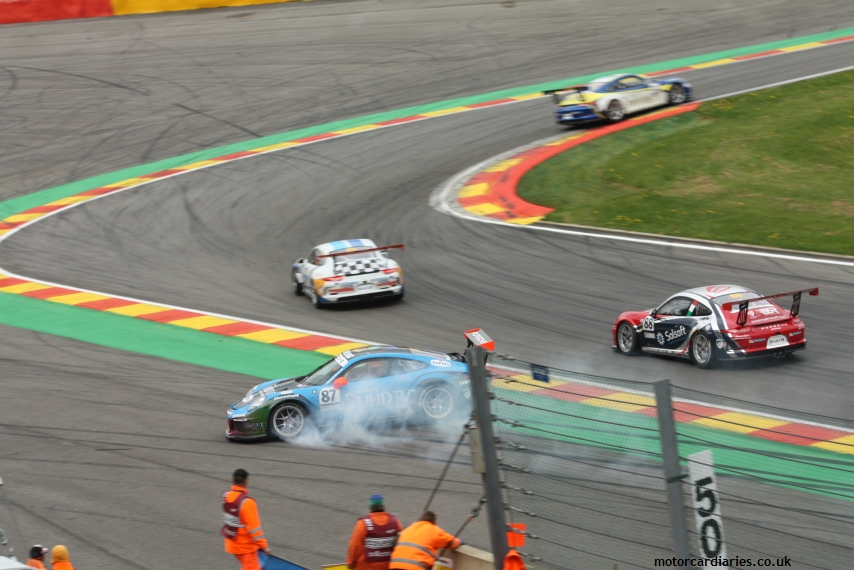
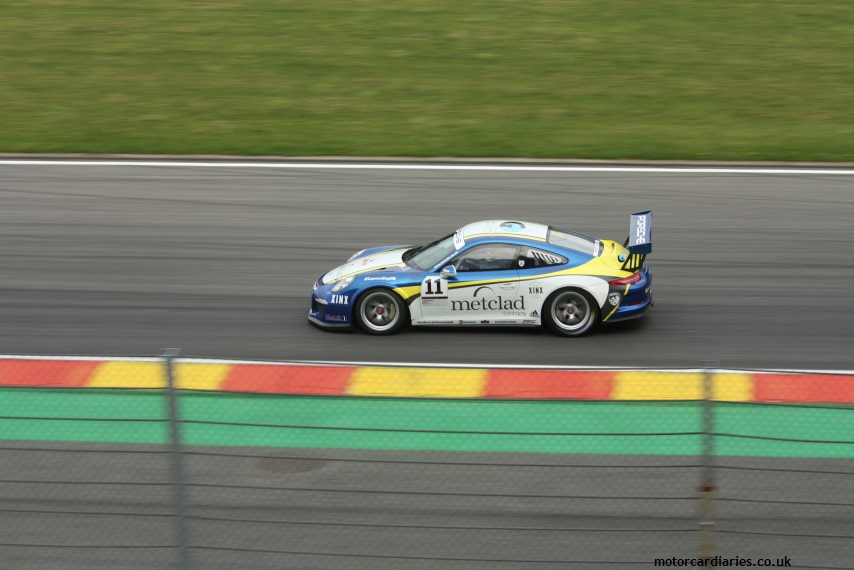

All that remain are two qualifying sessions for the World Endurance Championship and they promise to be thrilling. The season opener at Silverstone had been too close to call – with Porsche phenomenally quick in a straight line; Audi bringing awesome downforce and Toyota close behind on both fronts. Behind them, LMP2 at Spa promises great things with reigning Le Mans champ Jota Sport bringing its open-top Gibson to upset the ORECA / Ligier party. In a session of their own, the GTE runners are equally mixed up with Aston Martin looking good after Silverstone but who’d want to count out Porsche and Ferrari?
We perch on the old pit buildings, overlooking the cars as they hammer out of La Source, steeply downhill before plunging into the compression of Eau Rouge and firing up Radillion and out of our sight. It’s a brief glimpse of automotive fury, no more than a couple of seconds but it’s a compelling place to watch fast cars. Forget all the chat in F1 about this complex no longer being a challenge; in a GTE car the difference between the drivers is marked. There’s no hiding if you jump out of the throttle here.

The grid is decided from aggregated times set by two drivers in each car. GTE Pro is too close to call with Ferrari, Aston Martin and Porsche all quick. It comes down to consistency with the #99 V8 Vantage of Alex Macdowall, Fernando Rees and Richie Stanaway pipping the Ferrari duo of Gianmaria Bruni and Toni Vilander by less than a tenth of a second. The variety in the class remains fascinating, with the brutal Astons and lone Corvette thumping the macadam in defiance, while the 458 Italia howls longest and hardest, it’s coarse flat-plane crank bestowing it with the loudest and most distinctive voice in the entire field. It’s no Colombo V12, perhaps, but it sounds suitably evocative out here in the Ardennes forests.

The prototype session mixes LMP1 and LMP2 runners, though the quickest LMP2 runner – the #26 G-Drive Ligier – is less than ten seconds off the back of the LMP1 field. It’s fascinating watching the cars’ behaviour. Most of the cars are grounding out in the compression, with puffs of smoke as their planks strike the macadam, leaving a light mark on the surface. The mighty Porsche 919s, though, are sending a shower of sparks in their wake. It’s truly dramatic and the photographers are loving the spectacle with a pack of them crouching on the outfield awaiting each 150mph pass. There are few more impressive demonstrations of the astounding performance of a modern sports prototype than this. It’s mesmerising watching the cars twitch and pitch, right on the edge; just for a second and then they’re gone, pounding out into the countryside and following in the wheel tracks of virtually every great racing driver of the last hundred years. Special stuff.


It’s something of a surprise to notice that the KPMG Oreca is cocking its inside rear wheel under maximum provocation through the right-hand section of the corner. These things are working hard; imagine that relentless strain for six hours.

The LMP2 line-up reiterates the results from the WEC and ELMS at Silverstone, proving that the new breed of coupé won’t have things all its own way this year. The surprise of the session is the Morgan of the beleaguered SARD team which emerges second in qualifying; derived from a design which dates back a decade and fielded by a team in a state of some turmoil.

The LMP1 field is more clear-cut with Porsche’s mighty 8MJ hybrid system working perfectly in Belgium. Boasting a three-car entry in preparation for Le Mans, the team steals the first three grid positions, with the #17 of Bernhard, Webber and Hartley snatching pole ahead of interlopers Hülkenberg, Bamber and Tandy. It’s a remarkable effort by the new boys to beat the experienced hands in the #18 car. With Audi occupying the next two spots, Toyota is – relatively – nowhere in what was to prove an ominous portent for the balance of the season. Silverstone, sadly, was a flash in the pan and the TS040 wouldn’t look a competitive force again until Bahrain at year’s end.


Porsche’s domination of the session effectively brings the curtain down on another wonderful road trip. While a Belgian traffic jam threatened to delay us sufficiently to miss our train, we just get to Calais in time and are reluctantly spat back out onto the British motorway network. It’s been another unforgettable trip with the little Aston providing wonderful driving memories and our heroes thrilling us out on the race track. Final thoughts go out to Otakar Kramsky and his family; rest in peace.