Mulhouse, from the little we saw of it, is an industrial town with its railway as the centre of activities. The place didn’t seem particularly note-worthy for the visitor, though some unseasonally precipitous weather may not have helped. It has, however, fallen into legend in automotive circles courtesy of the Schlumpf brothers; Hans and Fritz.
The story of their car collection is well-known but it’s worth a brief summation. The brothers were successful entrepreneurs in the textiles industry in Mulhouse. As their various business interests burgeoned, so too did their desire to procure automobiles. This hobby was predominantly the obsession of Fritz. He furtively built an enormous collection of important classic cars in a relatively short period through the 1960s, though he had bought his first Bugatti before World War Two.
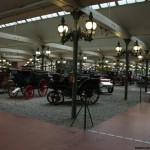
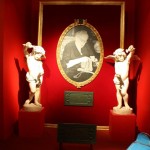
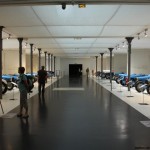
Such was the scope of the collection; restoration of the contents necessitated the employment of a small team of mechanics, with all the cars stored in one of the brothers’ mill buildings. Fritz secretly planned to publicly exhibit his collection and set about converting one mill into a dramatic museum. All internal partitions were knocked down to create one vast room, illuminated by ornate Parisien-style street lamps and containing, quite literally, miles of tiled walk-ways. A dramatic entrance was added, lavish lavatories and a tribute to the brothers’ mother, Jeanne.
The collection achieved international notoriety prior to its public unveiling, however. As Fritz’s automobile purchasing intensified, so the textile business declined and industrial action increased, as relations with the brothers’ 2,000 workers deteriorated. In 1971, industrial action forced the brothers to flee Mulhouse for Switzerland – where they remained. For a remarkable five years, they continued to hold control of their company remotely, from abroad, before things reached a head in 1976.
The brothers’ mills were placed into receivership, which triggered a chain of events which became known as the ‘Schlumpf Affair’. Government subsidies dried up, arrest warrants were placed on the brothers’ heads and their assets seized. In early 1977, a small group of displaced workers found their way into the Heilmann, Koechlin, Kuneyl & Co. Mill which housed the automobile collection. They found upwards of 500 cars, either on display or resting in the workshops. Realising they had stumbled upon something rather special, the workers took occupancy and pronounced it ‘The Workers’ Museum’. Remarkably, the workers occupied the museum for two years and despite the sometimes rather volatile nature of disgruntled trade unions, they elected not to damage the precious exhibits.
In 1981, a partnership of seven organisations became the owners of the collection, operating on a not-for-profit basis. Finally, the museum opened to the public in July 1982, to public rapture. Today it is known as the Cite de l’Automobile – Collection Schlumpf.
Fast forward 30 years and we’re in. Despite a basic knowledge of the history of the museum and some of its contents I’d deliberately not read up too much in order to allow for some element of surprise. Well, I needn’t have worried – the main exhibition hall knocks the air out of your lungs. It is simply enormous, with row upon row of old cars neatly displayed on gravel beds. There really are hundreds of them. The repetition of design with those famous street lamps and the orderly, regular 6m wide walkways, flanked by mirrored walls is quite hypnotic. It is genuinely over-whelming.
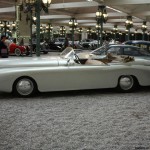
I won’t linger too much on individual cars as there simply isn’t the time to do justice to everything, nor will my memory flatter me so. Suffice it to say, though, that Fritz had extravagant tastes; not for him modern phenomena such as ‘bargernomics’. The exhibits are mostly extremely high-end with the famous focus on Bugatti, though, Mercedes-Benz, Alfa-Romeo, Ferrari, Hispano-Suiza and Rolls Royce also feature strongly.
The main room focuses on road cars and features an extraordinary number of veteran bolides – by far the largest single collection in the world. In fact, as one explores the long boulevards of these very early cars, tracking their development, it seems hard to believe so many exist anywhere, let alone in a single room. The whole history of motoring is explored from its genesis through to the 1970s – where of course the Schlumpf brothers’ collecting came to an abrupt end.
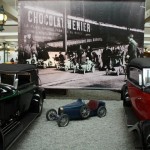
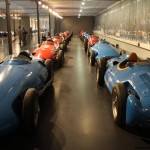
In the wings of this vast main room are a number of smaller displays. The most exciting of these for me is La Course Automobile – a brightly illuminated avenue dedicated to the racing car in its various forms. There are, of course, a good number of Bugattis. In fact there are a bewildering number of Bugattis scattered throughout the museum. I profess no expertise on the marque so it becomes hard to ascertain the significance of exactly what one is looking at.
That visage of sky-blue is further supplemented by a good number of Gordinis as well. Fritz Schlumpf had varied tastes but there is a welcome partisan theme which runs throughout the collection. This is, after all, the French national motor museum and should, I feel, reflect that status.
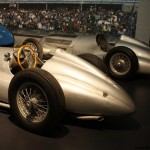
Among the racing cars, which are, seemingly without exception, rare and important, the highlight is a trio of Mercedes-Benz. I do not know enough about Fritiz’s procurement methods to comment on how he came about this trio, but his techniques appeared to be robust, thorough, and with scant regard for cost. Fritz had somehow obtained a 300SLR from 1955 – apparently the only outside of works ownership. It shares a room with examples of both of the mightiest pre-war racers – the savage W125 and its successor, the W154. At one stage, Fritz owned two W154s; truly, the mind boggles…
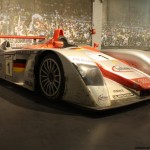
The racing car avenue does feature some more modern machinery which has clearly been added since the nationalisation of the collection. Several modern sports prototypes rub shoulders with recent Formula One cars with a French connection. Again, it’s nice to see a little national pride reflected in the choice of exhibits.
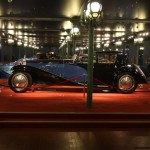
The opposite end of the museum is in stark contrast to the brilliant white light of the racing car display. Here, the most opulent conveyances of all time are congregated, bathed in subdued blue light. The number of high-end pre-war cars in such a small space is staggering – including the obligatory Bugattis. Pride of place among the exhibits sits the pair of Type 46 Royales. With only six produced, this represents a third of the total production, though the museum also houses an evocation of a third – the famous Esders car created using many original parts.
The brothers owned perhaps the most famous Royale of all – Ettore’s own Coupe Napolean. This particular model features coachwork by Ettore’s then 20-year old son Jean. Somehow, seeing the Royales sitting nobly on plinths slightly higher than the other cars, it seems like they’re at home. At one stage, Fritz had made an open offer to the Bugatti-owning fraternity to purchase every single vehicle made available to him. It does feel very much as if this is a fitting, loving home for all the amazing machines from Molsheim.
I won’t dwell further on the collection. Until you stand, slack-jawed at its scale and depth of importance, it’s impossible to believe. However, it must stand as one of the – if not the – definitive car collections in Europe. Outstanding.
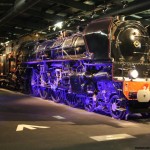
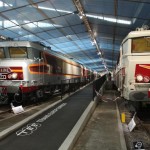
Mulhouse, however, also houses the French national railway museum which we felt duty-bound to visit while we were there. A pair of geeks must always remain true to themselves, after all. The two museums are a couple of miles apart so don’t be tempted to walk between them. The Cite du Train is well worth a couple of hours, though.
I cannot profess to any great knowledge on railway history but I’m a keen student of anything mechanical. Mercifully the old chap is a fountain of knowledge on the subject so I was able to learn much. Of course four months later I’ve forgotten most of it but I found everything utterly fascinating at the time. Given France’s rather larger footprint than the UK, as well as its borders to the rest of Continental Europe, it’s easy to see why the locomotive is so popular.
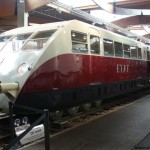
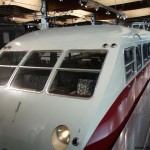
We saw many hulking monsters describing the history of the locomotive and its sundry rolling stock. There was one obvious and wonderful highlight: the Bugatti railcar. This was Ettore’s vision of passenger rail transport – and it must have looked phenomenally bold in the early 1930s. The first railcars used remaining stocks of the Royale’s mighty 12L straight-8 engine. In the end 79 were built powered variously by two and four engines working together. These became the fastest trains in the world during the mid-1930s and one can only imagine how radical the sleek bodies and relative paucity of blood n thunder must’ve seemed back then when compared to the traditional steam train.
The driver piloted the little railcar from a raised observation dome in the centre of the vehicle. It looks slightly odd by modern standards but makes perfect sense as the railcars could be easily driven in either direction, the mechanicals were kept separate to the passengers and the occupants could fill the carriages right to the front and back. The diplomatic description in the museum pays only brief lip service to the fumes the drivers inhaled in the proximity of those enormous engines.
I cannot pretend to speak on the matter of French locomotives in any greater detail than that. Predominantly I was pleased to see my dad indulge in another of his great passions; I think he enjoyed the break from cars. Maybe in some vague respect I did too. I wouldn’t like to admit it publicly though.
So we returned to the sleeping Aston and started to plot our route north. We were both a little anxious to get going as one of our longest single journeys lay ahead and it was already late afternoon. We were spearing North West into France, away from the borders with Germany and Switzerland, bound for the champagne region – specifically the town of Reims. This has become a great mecca for racing enthusiasts and we were excited to make our own pilgrimage.
As this leg comprised mostly fairly boring dual carriageway motoring, I volunteered to do some driving to let the old chap have a rest. I don’t think I’d ever adjust to the novelty of sliding down into the depths of an Aston Martin and firing up that Brunellian V8. It’s a rarified world to step into for a week or two as an imposter.
I soon found myself regretting my altruistic gesture. The lower the sun set and the further north we travelled the worse the weather became. The rain was biblical and I came to learn a little of the French autoroute network which surprised me. Not assisted in our voyage by headlamps pointing in very much the wrong direction, we paid for the privilege of using the peage. Blessed with slightly more relaxed speed limits than we British motorists are accustomed to, these are relaxing places to cover distance during fine days.
To tackle this particular stretch in heavy rain at night is quite a different matter: the road surface doesn’t drain well; there are minimal cats’ eyes and no overhead street lamps. Struggling to pick out the standing water and with little clue which way the road ahead curved I arrived four hours later in Reims feeling elated simply to have delivered this special car and its weary occupants in one piece. It remains the single most stressful drive of my life. Still, even a relatively modest Mercure hotel in France does a decent supper and with ample red meat and a couple of lager inside us we were able to relax a little. It was important to enjoy the next day as it represented the final day of the trip in the Continent.