With body and brain just about recovered from the previous day’s driving trauma, any lingering anxiety was soon brushed aside by a splendid French breakfast. Nobody does pastries quite so well as our Gallic cousins.
This was our last day on the Continent and a fairly relaxed schedule was planned, so we could afford to take our time over breakfast. We resisted the temptation to stock up on the local champagne – the excuse being the boot was already full. The truth was actually that I only tend to enjoy champagne when it comes to me gratis. And judging by the hotel’s prices, their bottles were very definitely not gratis. You can take the man out of Yorkshire, etc.
I think by this stage, after two full weeks on the road, we were actually quite grateful for a slow start to the day. We packed up the car and set the sat nav for the village of Gueux. First there was the small matter of fuel to attend to. Having never owned a gas guzzler on this scale before, the Vantage’s thirst for super unleaded was faintly shocking. The tank is enormous but even a gentle cruise causes the needle to drop alarmingly rapidly. On the autobahns it was drinking with the kind of vigour which would’ve made Oliver Reid blush.
After a tiresome journey the previous day we had decided just to get to our destination safely and worry about fuel in the morning. Well, worry we did. Every petrol station we tapped into the sat nav seemed to be disused. Ambling around the French countryside performing periodic u-turns was only serving to further empty the tank. Nervous looks were exchanged, vague panic set in, tempers frayed. Of course, eventually we located a petrol station, brimmed the tank with 99RON and proceeded without issue, but it was a tense moment and a pertinent reminder always to keep the tank well topped-up when you’re far from home.
The town of Reims, it would seem, is famous for three things: champagne; a beautiful cathedral; and a now-defunct motor racing circuit. As described, my appetite for champagne diminishes significantly when faced with the bill and my interest in ecclesiastical architecture is limited at the best of times, so we did the dutiful thing and headed out of Reims and towards the village of Gueux to find the legendary circuit.
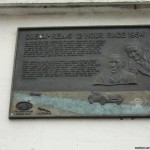
Le Circuit de Reims-Gueux is one of a handful to have held the French Grand Prix during the race’s 100-plus year history. It also commands a proud heritage of sports car, motorcycle and even club-level racing. The layout itself follows the Continental tradition of conveying the brave pilots from one village to the next at break-neck speed. From that perspective it is very much like one can still see today au Mans and Spa Francorchamps. However, while those two wonderful old circuits continue to build their legacies through ongoing adaptation and racing, racing at Reims petered out in 1972.
The track – it seems colloquially to be known simply as ‘Reims’ – actually links the villages of Thillois and Gueux, sitting a few miles due east from Reims itself. The layout has been through three variations, with the final one the lengthiest, and the fastest. Historically, it was one of the absolute fastest circuits on the calendar with long flat-out straights punctuated by a couple of slow corners.
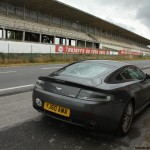
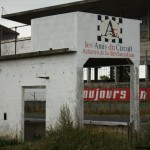
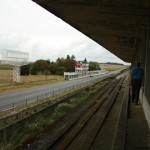
Today, it exists as something of an anomaly in the sport’s history. One short section of track no longer exists, but otherwise the public roads still stride their way through the countryside in a fashion which Fangio would still recognise. Equally, many of the buildings and structures clustered around the start line still exist – in varying states of dilapidation. It is these remaining monuments, and the unique atmosphere they bestow, which draws racing fans back to this special spot, in an otherwise anonymous corner of France.
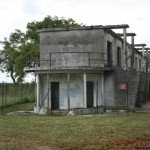
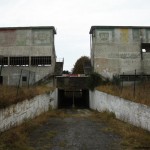
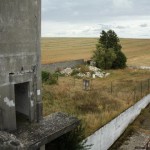
Having only a few days earlier rued the slow ruin of Monza’s mighty banking; it was hard not to feel that slight tug on the heart strings at Reims. The mighty tribune is officially a no-go zone, but dad and I felt compelled to explore – and there was no sign of anybody around to object. This great concrete structure is mostly intact, but showing signs of the same fate which is slowly eroding the Monza banking. With insufficient concrete cover over the steel reinforcement, that steel is being exposed to the elements where it is rusting and blowing the surround concrete. The damage isn’t terminal but, if the tribunes are to remain standing deep into the 21st century then some remedial work will be necessary.
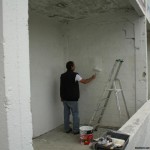
The good news is that help is at hand. Quite by chance, as we prepared to leave, we chanced upon a gentleman with paint brush in hand, working away at one of the old pit blocks. Gérard Cuif talked us through the struggles facing the circuit and the hard work invested by Les Amis de Circuit, a group founded to protect the facilities. I subsequently interviewed Gérard for an article here: http://www.motorcardiaries.co.uk/2012/le-circuit-de-reims-gueux/
It was encouraging to learn that there is a body devoted to maintaining the various buildings on the site, but also sad that it is necessary for private individuals to stand alone as this voice, without wider representation from architectural, sporting, or local government bodies. It will be interesting to see what the coming years hold for this remarkable site.
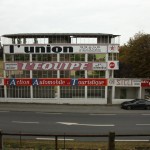
And remarkable it is. As well as those looming tribunes, the old pit block is almost entirely intact, complete with timing tower. These have been renovated and re-painted, looking very much as they would have done in period. Beside them sits the old rotating timing board. A huge steel structure on a turn-table base, this is once again ready to carry the great names of the past: Moss; Fangio; Hawthorn; et al.
Awaiting similar renovation are the media building and the block employed by drivers for rest during the gruelling 12 hour sports car slogs. These are both in a fairly poor state, but not beyond sympathetic restoration, something which Gérard promises is next on the list.
Of course this leads onto the debate over what is appropriate renovation under these circumstances. How much of the original buildings should be maintained? Should they once more serve a useful purpose or simply stand as monuments? Instead should they be allowed to crumble as nature intends? So many rhetorical questions.
Personally, while the fading grandeur look is terrifically fetching and atmospheric, as a rare monument to a by-gone era of our sport, I can’t help feeling the buildings should be protected. I came away feeling a structural survey should be undertaken in the first instance, and sympathetic work to safeguard the fundamental future of the buildings is essential. Beyond that, redecoration is tinsel. The freshly painted areas of the pits look wonderful. You can imagine teams of mechanics sloshing fuel into Lancia-Ferrari D50 ‘Hammerheads’; glamorous wives sat on the pit wall, keeping better lap charts than any team manager; drivers reclining on the grass behind the pits between stints at the wheel, wiping the grime from their faces.
It is equally fascinating to see those areas of the site where the weather and time have ravaged the old concrete and nature has been allowed an influence. There is something earthy and elemental about that which carries an atmosphere of the times just as powerfully as the brightly-painted pits. They can fade, but they cannot be allowed to fall down.
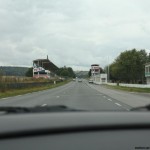
After a couple of hours exploring the site and many minutes spent pondering our heroes who pounded the track in days gone by, we decided to have a lap ourselves. The layout you now traverse is an early iteration, but allows the driver to follow the same path and contours as the racers in the last century. It’s an extremely fast lap, much of it would’ve been on the rev limiter in top, I suspect. It’s hard not to recall that famous battle between Fangio and Hawthorn for supremacy in the 1953 Grand Prix; imaging the two men side-by-side as they thunder through the final tour. In spite of the slightly anodyne nature of today’s dual carriageway, there remains a little magic in the air.
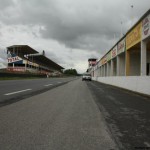
We don’t lap quickly, but enjoy the flow of the track and allow it to conjure those mental images of the greats at work. There is something very special about hammering down the old start-finish straight, tribunes on the left and pits on the right. In my experience, there is nothing else quite like it left for the public to enjoy on Continental Europe.
We stopped in the village of Gueux where we chanced upon a friendly restaurant, the Bistro du Circuit, and one evidently very proud of its local history. The walls are generously adorned with photographs of the track throughout its lifetime. Of particular fascination was one of the awesome Mercedes W154s which bludgeoned the track in 1938. Oh, to have stood out in that quiet corner of the French countryside and savoured the savagery of its sonic delivery peeling across the fields…
With food eaten and enjoyed, it was time to nose north towards our submarinal locomotive. We had just a couple of hundred kilometres of autoroute left to Calais and then it was back to Blighty, and the real world once more: Except, we could stretch out this little automotive fantasy another few days. Three days at the Goodwood Revival beckoned and a last chance to soak up the all-consuming automotive indulgence and nostalgia before everything was committed only to memory.
We arrived safely back in Sussex late on Wednesday evening, almost exactly 14 days after we first converged. It had been a remarkable couple of weeks, and certainly a trip I imagined could only ever remain a dream. The car was amazing and we both thoroughly enjoyed driving and passengering in it. It never missed a beat and the universal appreciation from the kind inhabitants of Continental Europe was genuinely uplifting. It was an honour.
If you’re reading this and tempted by a trip of your own, then book it: Sell your dog; pimp out your wife; turn your horse into a lasagne; whatever it takes. Of course the problem is that you can’t help planning the next one. With that in mind, Mrs Motorcardiaries and I have just booked flights to Australia for October. We’re off to Bathurst to see how the Aussies go about their racing. While we’re out there we may find time for some MotoGP action at Philip Island and a drive of the Great Ocean Road. Then there’s that trip we quite fancy to Austin for the 2014 Grand Prix – surely we’ll find some NASCAR to watch too. And so it goes on…